

Practical Strategies to Maximize Your NSLP Funding | Part 4: Enhance Meal Service with Operational Efficiency
In today’s ever-shifting educational landscape, school leaders face mounting pressure to do more with less. Unpredictable funding, rising food and labor costs, and evolving compliance requirements all make running a successful meal program more complex than ever.
That’s why we launched this blog series—to provide clear, practical strategies that help charter schools maximize their National School Lunch Program (NSLP) funding while delivering nutritious, high-quality meals to students.
In Part 1, we explored how expanding breakfast participation can generate thousands in additional revenue. In Part 2, we walked through how strategic vendor selection can improve quality and reduce costs. In Part 3, we tackled food waste—offering proven strategies to cut inefficiencies and protect your budget.
Now in Part 4, we’re focusing on how schools can enhance daily meal service operations to boost participation, improve the student experience, and reduce strain on staff.
Why Operational Efficiency Matters
Efficient meal service systems not only support student wellness—they also drive revenue. According to the USDA, increased participation directly correlates with greater federal reimbursements under the National School Lunch and Breakfast Programs. Yet for many schools, outdated workflows and equipment can create bottlenecks that discourage student engagement.
Operational efficiency can lead to:
- Shorter wait times, encouraging more students to participate
- Improved food quality, with meals served at the right temperature
- Higher staff morale, through more streamlined routines
- Greater compliance, by reducing administrative and service errors
Strategies to Improve Meal Service Efficiency
Here are several research-based strategies schools can implement to enhance their meal service with operational efficiency:
1. Redesign Service Lines for Flow and Access
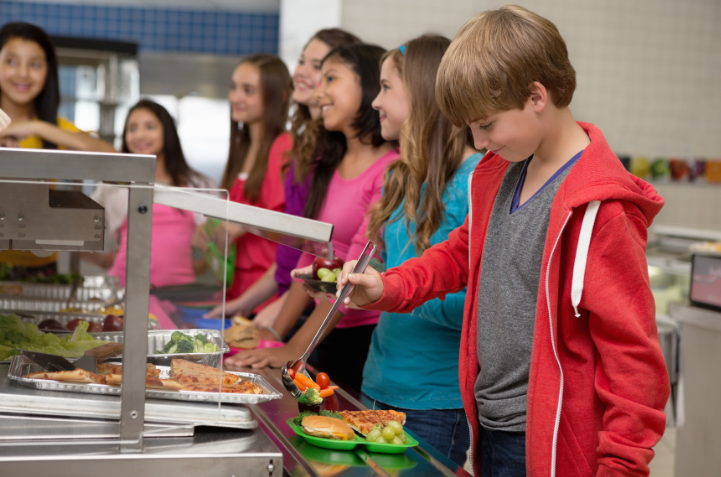
The physical layout of your service line directly influences student behavior. Crowded, confusing, or slow-moving service lines can potentially discourage student participation due to congestion. Simple changes like visual signage, dual-service lines, or dedicated express lanes can improve throughput.
According to the Institute of Child Nutrition (ICN), reorganizing serving areas to minimize congestion is a top strategy to increase efficiency and student satisfaction.
Vertex Tip: Observe student movement during meal times and adjust line configurations, such as a second service line, to minimize bottlenecks and idle time. Additionally, use floor tape, signage, or stanchions to guide flow while positioning popular items at the end of the line.
2. Implement Point-of-Sale (POS) Technology
Modern POS systems, such as touchscreen kiosks or barcode scanners, can reduce transaction time and streamline compliance with federal meal counting requirements. Today’s POS solutions are designed for speed, flexibility, and reporting accuracy.
Implementing electronic POS systems can improve efficiency by cutting wait times by 70%, increasing student participation by reducing delays.
Vertex Tip: Position POS stations where they won’t interfere with food distribution and consider multiple checkout points for larger schools. If necessary, invest in POS training so staff are fully comfortable.
3. Offer Pre-Packaged or Grab & Go Options
Grab & Go service models—already popular in breakfast programs—can also be used during lunch to ease congestion and offer flexible access. They allow students to quickly pick up meals from high-traffic areas and eat in alternate spaces.
Research from No Kid Hungry shows that Grab & Go models significantly increase meal participation, especially when integrated with Offer vs. Serve strategies.
Vertex Tip: Ensure your Grab & Go meals are pre-approved for compliance. Place Grab & Go carts near student entry points, gyms, or common areas during passing periods or lunch waves.
4. Train and Cross-Train Staff for Flexibility
Operational success depends on the people behind the scenes. Investing in regular training and cross-training staff for multiple roles ensures consistency even during absences or staff turnover. Staff development contributes directly to smoother operations, better food safety practices, and increased morale.
Vertex Tip: Schedule brief weekly check-ins to identify service challenges, gather team feedback, and celebrate wins.
5. Use Scheduling to Stagger Meal Periods
In some cases, inefficiency is tied to how students are scheduled for meals. Where feasible, staggering lunch periods or adjusting release times can help distribute foot traffic more evenly across service windows.
Vertex Tip: Partner with school leadership and operations staff to review bell schedules and meal period layouts for opportunities to increase flow.
Thoughtful Design = Better Outcomes
When school meals are easy to access, appealing, and served efficiently, students are more likely to participate—and more participation means more funding.
Efficiency doesn’t require a full kitchen renovation. Often, the biggest gains come from simple adjustments, staff collaboration, and a willingness to test and refine.
Our NSLP team can support you with service line assessments, equipment recommendations, and implementation strategies that work within your space and budget.
Leave a Reply